
Entry Information
Shu-Jen Wang
Dr
Male
01/02/1992
Taiwan
Passport
RB419
New Zealander
Email hidden; Javascript is required.
+85252097968
Department of Physics, HKBU, 224 Waterloo Road, Kowloon Tong
Hong Kong
Hong Kong
Life Science and Medicine
Mathematical Sciences
It is my great honour to apply to join the Hong Kong Laureate Forum. I begin my independent academic career in Hong Kong for over a year working on interdisciplinary research at the intersection between physics, chemistry and electronics to enable next generation bioelectronics and biosensor technologies. Prior to my appointment in Hong Kong, I have carried out my postdoctoral training in TU Dresden, Germany from 2019 and 2023 after I received my PhD from University of Cambridge, UK. This forum would provide me with the opportunity to exchange ideas and views on breakthrough technologies with world leading scientists and fellow young scientists. I believe this event would be important for me to expand my academic network and connections to foster new research collaborations within Hong Kong and beyond.
PhD Graduate
Physics; Electronics; Biosensors
Hong Kong Baptist University
Hong Kong SAR
First Academic or Research Referee *
Prof. Karl Leo
TU Dresden
Director
Email hidden; Javascript is required.
Second Academic or Research Referee
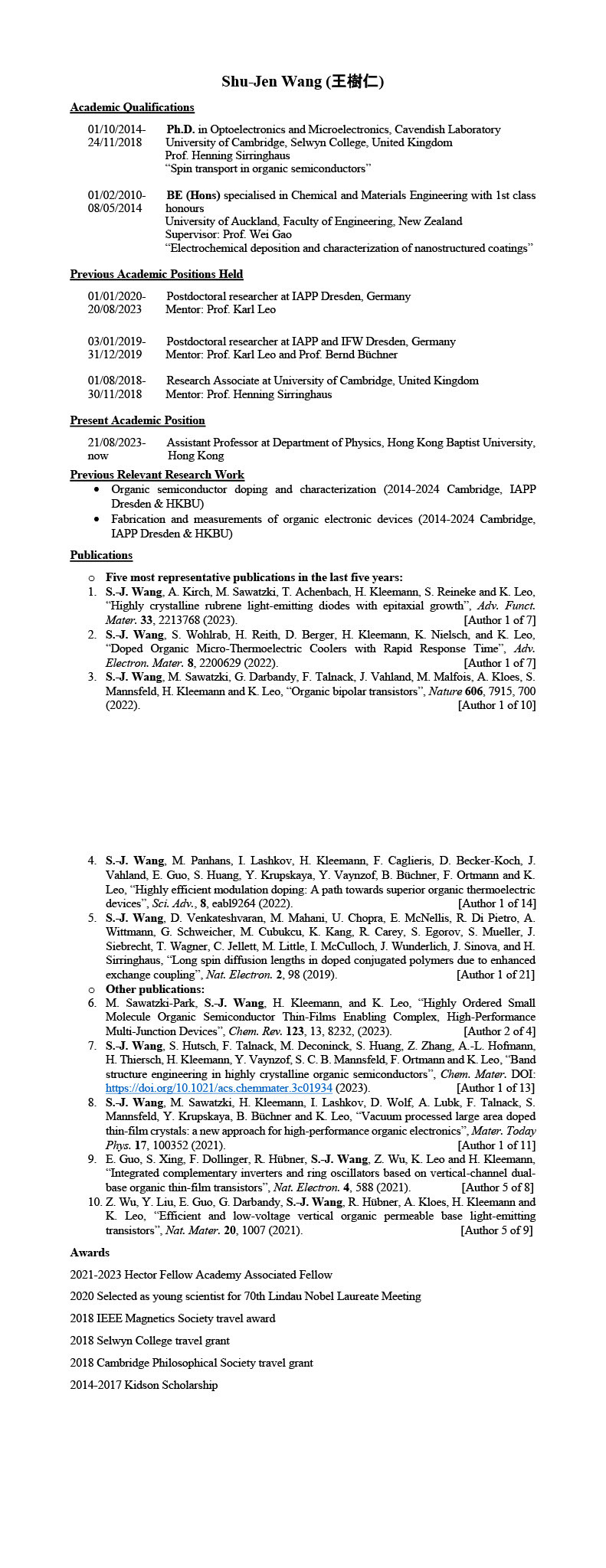
2021-2023 Hector Fellow Academy Associated Fellow
2020 Selected as young scientist for 70th Lindau Nobel Laureate Meeting
2018 IEEE Magnetics Society travel award
2018 Selwyn College travel grant
2018 Cambridge Philosophical Society travel grant
2014-2017 Kidson Scholarship
Organic semiconductors have revolutionized the small/medium display market and are enabling emerging applications such as bioelectronics, thermoelectrics and photodetectors due to their biocompatibility, excellent optical properties and low temperature processability with low carbon footprint. My current research interests are focused on developing new device concepts based on organic semiconductors together with innovative manufacturing methods to enable high performance biosensors, bioelectronics and neuromorphic computing hardware architecture.
Both Sessions
N/A
University