
Entry Information
Eslam Hamed
Mr
Male
03/06/1992
Egypt
Passport
A2730
Egyptian
Email hidden; Javascript is required.
+6584974852
37 Jurong east Ave1
Singapore
Singapore
Life Science and Medicine
N/A
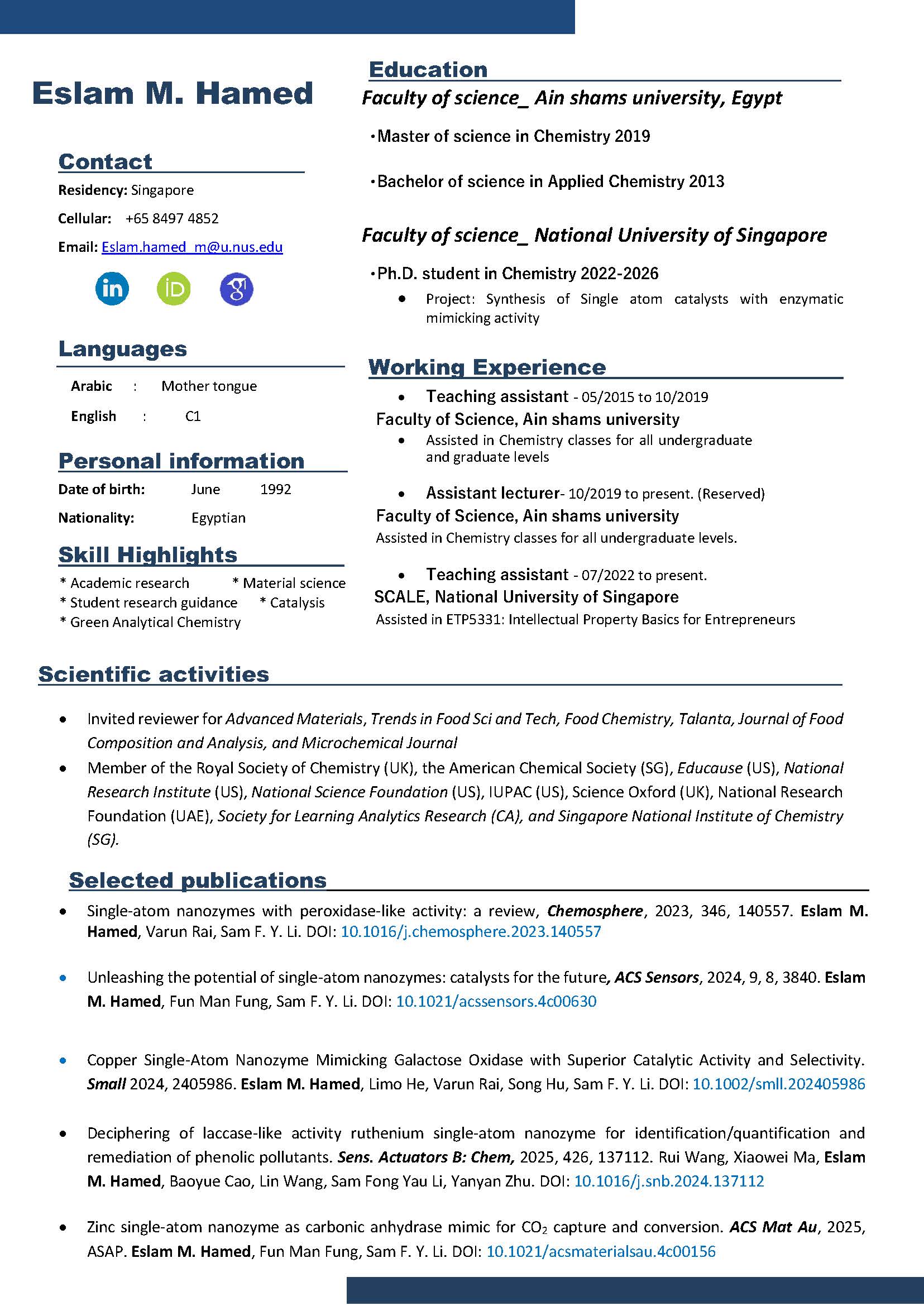
As a PhD candidate in Chemistry at the National University of Singapore, my research focuses on nanozymes and single-atom catalysts for environmental and biomedical applications. My work aligns with the Forum’s mission of fostering scientific exchange and advancing knowledge across disciplines. The Hong Kong Laureate Forum presents an invaluable opportunity to engage with esteemed scientists and like-minded peers, deepening my understanding of cutting-edge developments in chemistry and related fields.
I am particularly interested in exploring interdisciplinary applications of nanomaterials in biosensing and catalysis, fields that bridge chemistry, medicine, and environmental sustainability. Engaging with Shaw Laureates and distinguished experts will provide crucial insights into translating scientific discoveries into impactful solutions. Additionally, the Forum’s interactive sessions, discussions, and networking opportunities will enhance my ability to communicate complex scientific concepts effectively.
Beyond my research, I am dedicated to mentoring young scientists and fostering scientific curiosity. I actively engage in science communication and education, making this Forum an ideal platform to exchange ideas on nurturing the next generation of researchers. Participation in this prestigious event will not only enrich my academic journey but also enable me to contribute meaningfully to global scientific advancement and interdisciplinary collaboration.
Postgraduate (PhD)
Chemistry
National University of Singapore
Singapore
Prof Sam Li
Prof jason Yeo
First Academic or Research Referee *
Prof Sam Li
National University of Singapore
Professor
Email hidden; Javascript is required.
Second Academic or Research Referee
Prof Jason Yeo
National University of Singapore
Associate Professor
Email hidden; Javascript is required.
Nanozymes, artificial nanomaterials with enzyme-mimicking properties, have emerged as promising tools in biosensing due to their stability, cost-effectiveness, and tunable catalytic activities. This work focuses on developing and applying nanozyme-based biosensors, offering innovative solutions for precision detection in biomedical and environmental domains.
Our research investigates single-atom nanozymes (SANs) and multimetallic nanozymes with optimized catalytic efficiencies tailored for specific biosensing applications. We engineered zinc- and copper-based SANs that mimic natural enzymes such as carbonic anhydrase, galactose oxidase, and superoxide dismutase, enabling the detection of clinically and environmentally significant analytes.
The biosensors demonstrated exceptional sensitivity and selectivity, achieving detection limits as low as nanomolar concentrations. By integrating nanozyme-based sensors with advanced transducing systems, such as electrochemical and optical platforms, real-time monitoring capabilities could be achieved. These systems can be evaluated for point-of-care diagnostics, particularly for detecting biomarkers associated with diabetes, cancer, and infectious diseases.
A significant aspect of our work aligns with the UN Sustainable Development Goals, addressing food safety and environmental monitoring challenges. By employing green synthesis routes and recyclable materials, we ensured sustainability in biosensing technologies.
This research highlights the potential of nanozyme-based biosensors, bridging laboratory research with real-world applications to advance global efforts for a healthier and sustainable future.
Flash Presentation Session
N/A
University