
Entry Information
Long Hin David Tsang
Mr
Male
14/11/1995
Hong Kong
Hong Kong Identity Card
Y5047
Chinese
Email hidden; Javascript is required.
+4917647142389
Haydnstr.41
Dresden
Germany
Croucher_Foundation
Life Science and Medicine
N/A
As a PhD student in Germany, I am excited to see Hong Kong, my birthplace, launching a laureates forum to foster scientific exchange. I have heard from colleagues about the impact of such forums in europe, especially the Lindau Meeting, and believe this initiative will greatly contribute to local science development.
Also, my research institute is highly interdisciplinary, bringing together theorists, physicists, and biologists. I strongly believe that collaboration across disciplines is essential for scientific progress. This forum offers a unique opportunity to share my perspective, engage with young scientists from diverse fields, and learn from established laureates. I look forward to contributing to meaningful discussions on the future of science and staying in touch with the local scientific community.
Postgraduate (PhD)
Life Science
Max Planck Institute of Molecular Cell Biology and Genetics
Dresden, Germany
First Academic or Research Referee *
Prof Dr Meritxell Huch
Max Planck Institute of Molecular Cell Biology and Genetics (MPI-CBG)
Scientific Director
Email hidden; Javascript is required.
Second Academic or Research Referee
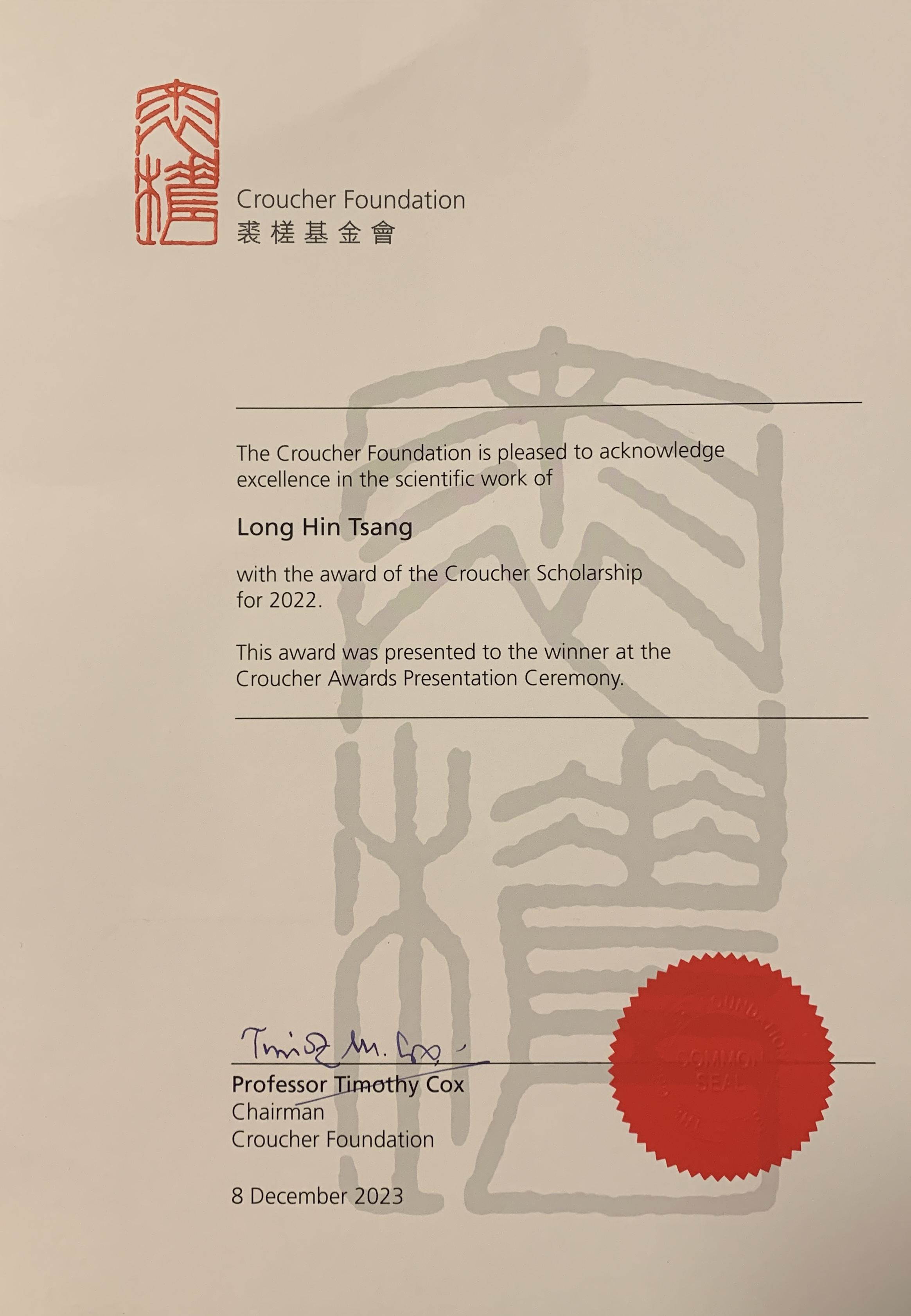
• Croucher PhD Scholarship (2022-2025)
• LMU@Lehre Student Research Award (2020)
• Dean’s Honour List, HKU (2018)
• HKU Worldwide Undergraduate Student Exchange Scholarship (2017)
Croucher Foundation
Tissue repairs depend on the ability of cells to respond to internal and external cues, proliferate and differentiate into functional components. The liver excels by its remarkable capacity to regenerate through either hepatocytes or ductal cells upon damage. However, aberrant regulation will result in disease.
Intrahepatic duct cells undergo major epigenetic remodelling in vivo upon severe liver damage and these changes are recapitulated during in vitro organoid initiation, which underscores the potential of using organoids to understand liver regeneration. Nevertheless, the regulatory mechanisms that dictate the activation and termination of the regenerative programs remain largely unknown. It is also unclear how the intrinsic differences contribute to the regenerative programs and how such differences change in subsequent damage.
My work combines in vivo, in vitro and in silico approaches to study the molecular changes in ductal epithelium after repeated damage. The result highlights a complex epigenetic mechanism behind the ductal-driven liver regeneration.
Both Sessions
N/A
Our email