
Entry Information
Hiu Laam Lee
Ms
Female
16/03/2000
Hong Kong
Hong Kong Identity Card
Y7595
Chinese
Email hidden; Javascript is required.
+85251144316
Room 02, 28/F, Wing Pak House, Hong Pak Court, Lam Tin, Kowloon
Hong Kong
Hong Kong
Astronomy
N/A
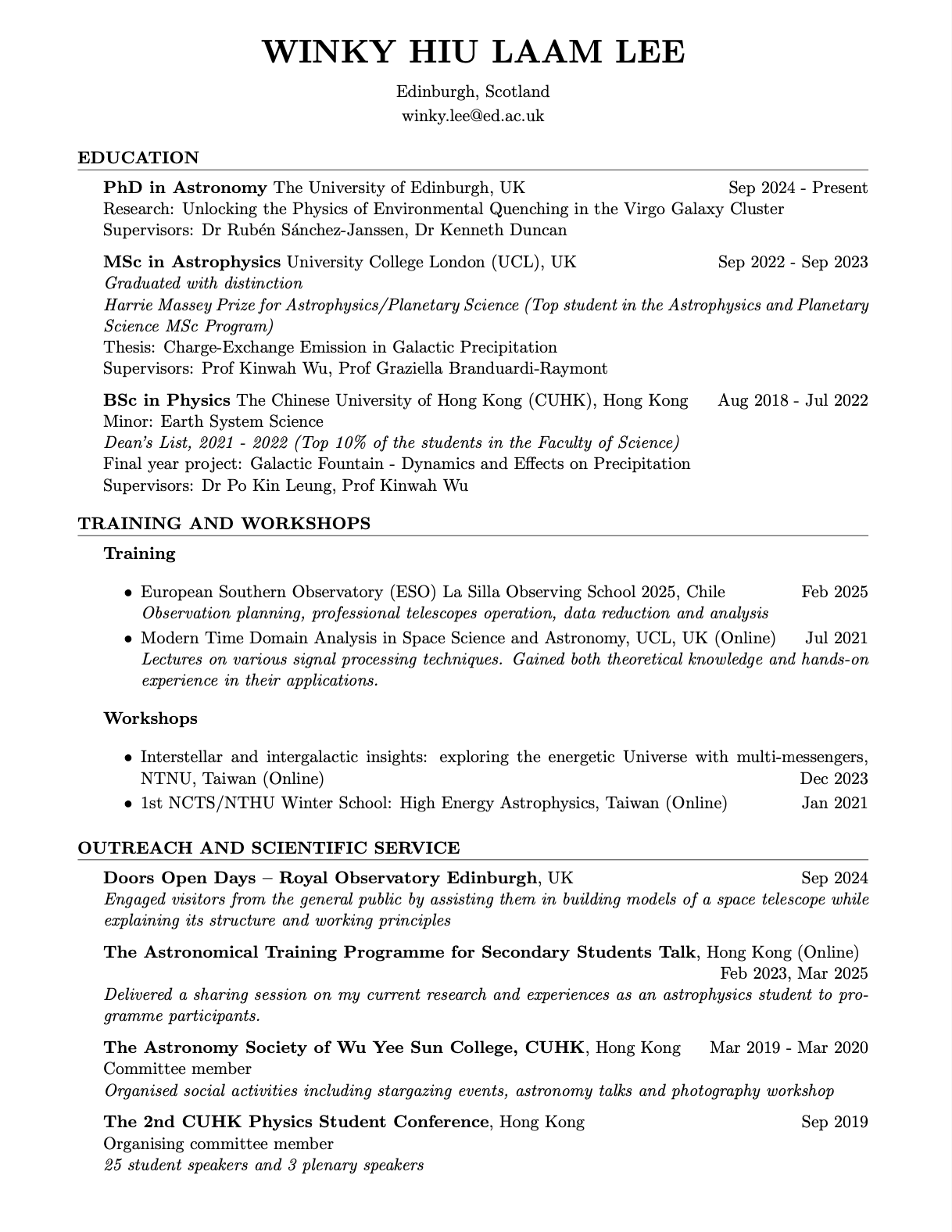
As a PhD student who grew up in Hong Kong, I am always grateful for how my education shaped me into a disciplined and perseverant researcher, equipping me with the resilience needed for scientific research. As I gained more experience in science, I became increasingly passionate about sharing its wonders and engaging with the global scientific community. I have always believed that Hong Kong has the potential to become a place where scientific curiosity flourishes, and I am eager to contribute to this vision.
My research focuses on galactic evolution, a frontier topic in modern astrophysics which involves extensive international collaboration. We analyse data obtained from telescope in Chile. We collaborate with fellow scientists from institutions across the globe. Through these collaborations, I have witnessed firsthand how interdisciplinary exchanges inspire new ideas and drive progress. The forum presents an exciting opportunity to extend this experience—to share my own research, build connections with astronomers from early-career to senior levels, and engage with scientists across disciplines, including life sciences and medicine. Being part of this event, in the place where I grew up, is especially meaningful to me as it represents Hong Kong’s growing role in the global scientific community.
Postgraduate (PhD)
Astronomy
The University of Edinburgh
Edinburgh
First Academic or Research Referee *
Dr Rubén Sánchez-Janssen
UK Astronomy Technology Centre
Astronomer and Project Scientist
Email hidden; Javascript is required.
Second Academic or Research Referee
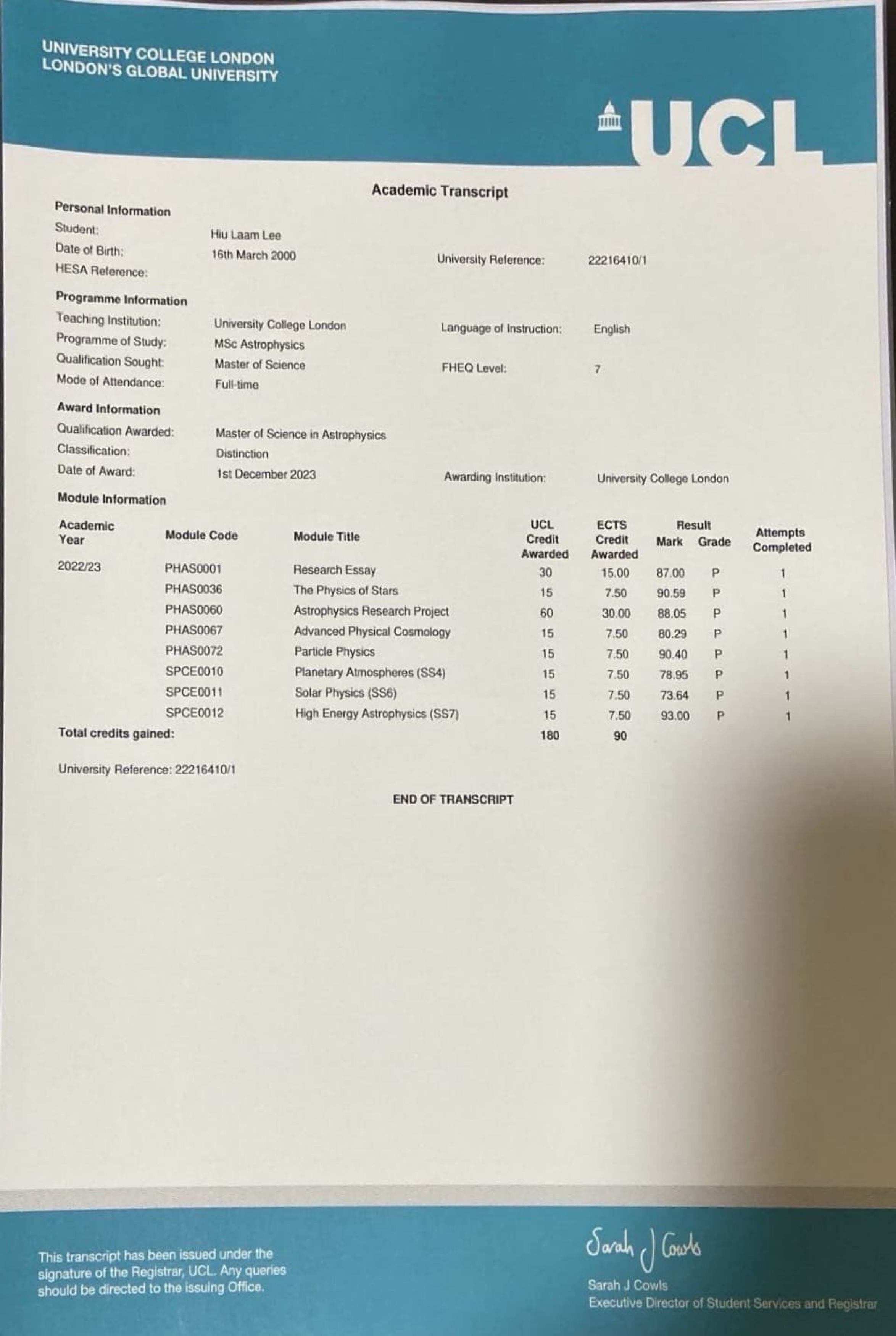
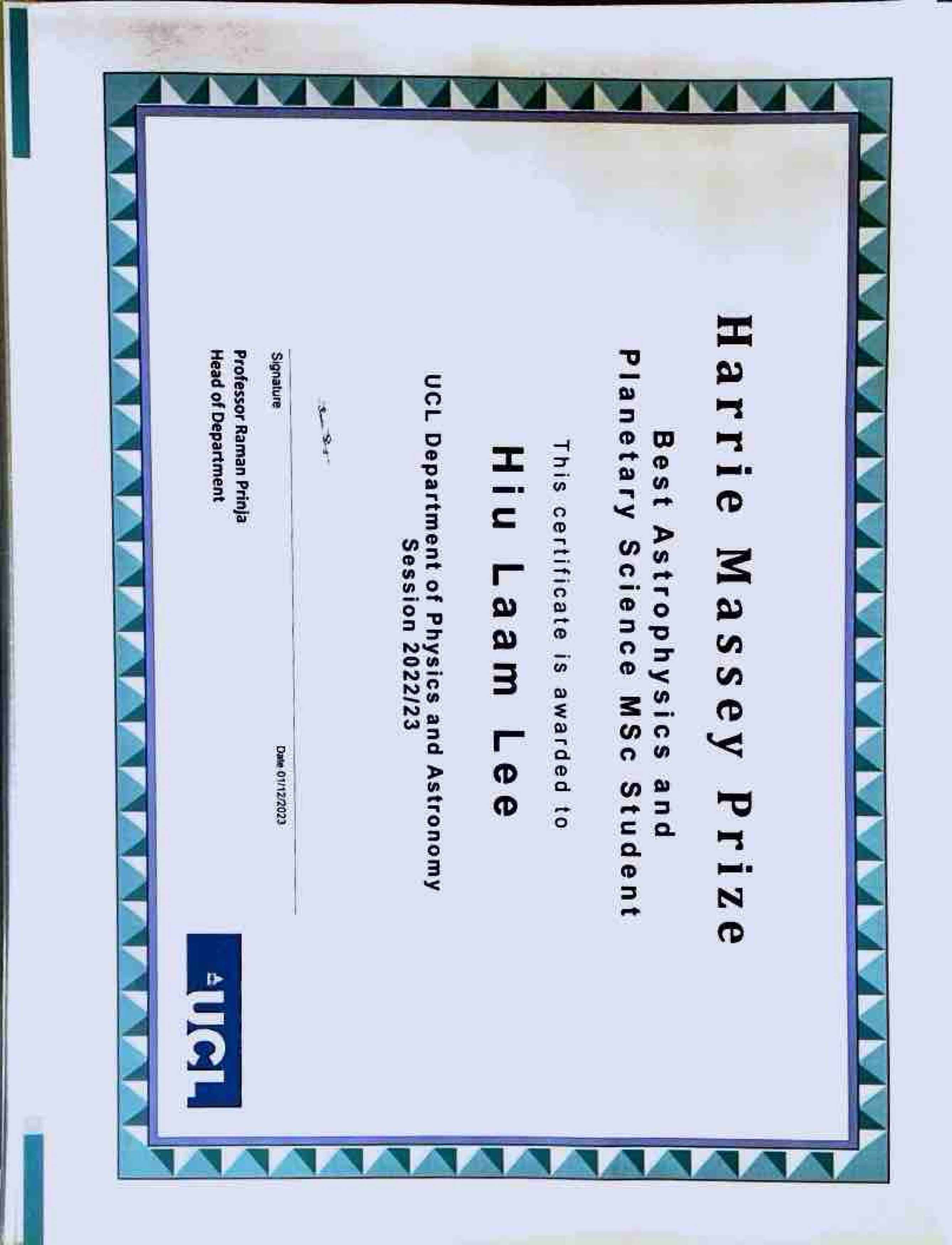
Harrie Massey Prize for Astrophysics/Planetary Science - Top student in the Astrophysics and Planetary Science MSc Program
University College London
The study of star formation in galaxies is crucial for testing our galaxy formation theories and cosmological models. A major challenge is understanding the transition from star-forming to quiescent states, which is shaped by a combination of internal and external mechanisms. However, the relative importance of these mechanisms remains a topic of active debate.
My research tackles this question by focusing on dwarf galaxies in the Virgo Cluster transitioning from star-forming to quiescent. Virgo is the nearest galaxy cluster, and it offers the perfect opportunity to study dwarfs with unprecedented detail and sensitivity. Using VLT/MUSE integral field spectroscopy, I investigate the properties of their spatially resolved star-forming gas of 70+ galaxies, which emits characteristic Hα emission lines due to ionization by young massive stars. In our sample, roughly half of the star-forming dwarfs exhibit off-centre star forming activities. By studying the properties of the satellites star forming region in the context of their orbital distribution using position-velocity phase-space diagrams, this will offer us new insights into environmental quenching of low-mass galaxies, eventually placing constraints on the quenching mechanisms in high density environment like the Virgo Cluster.
Flash Presentation Session
N/A
Peers