
Entry Information
Joanna Pikula
Ms
Female

16/05/2002
Poland
Passport
EM412
Polish
Email hidden; Javascript is required.
+447878132534
Flat 7, 18 South Carron Wynd
Edinburgh
United Kingdom
Life Science and Medicine
N/A
When I first learned that dementia could rob someone of their second language, it felt profoundly personal. English is not just a skill to me, it is woven into my identity. As a first-generation Polish immigrant in the UK from a low-income household, navigating school while overcoming a language barrier was deeply character-building. This prospect of cognitive decline reframed my interest in neuroscience from a predominantly academic pursuit to an urgent personal calling.
Motivated by this, I conducted my honours research on the role of perineuronal nets in prion disease neuropathogenesis. By using WFA1 staining to quantify perineuronal net integrity across key brain regions in varying contexts, I explored their potential role in prion-induced neurodegeneration. This experience not only strengthened my research skills but deepened my appreciation for the complexity of neurodegenerative diseases.
The Hong Kong Laureate Forum represents an invaluable opportunity to share my research, learn from others, and engage in cross-disciplinary dialogue. Neuroscience—and particularly neurodegeneration— demands collaboration to drive progress. Being part of a network of young researchers and esteemed laureates would be an honour, allowing me to exchange ideas and contribute to uncovering the underlying mechanisms of neurodegeneration and leading us closer to solutions to combat it.
Undergraduate
Biochemistry, Neuroscience
The University of Edinburgh
Edinburgh, United Kingdom
University of Edinburgh
University of Edinburgh
First Academic or Research Referee *
Prof. Stephen C. Fry
University of Edinburgh
Emeritus Professor of Plant Biochemistry
Email hidden; Javascript is required.
Second Academic or Research Referee
Dr Atlanta G. Cook
University of Edinburgh
Professor
Email hidden; Javascript is required.
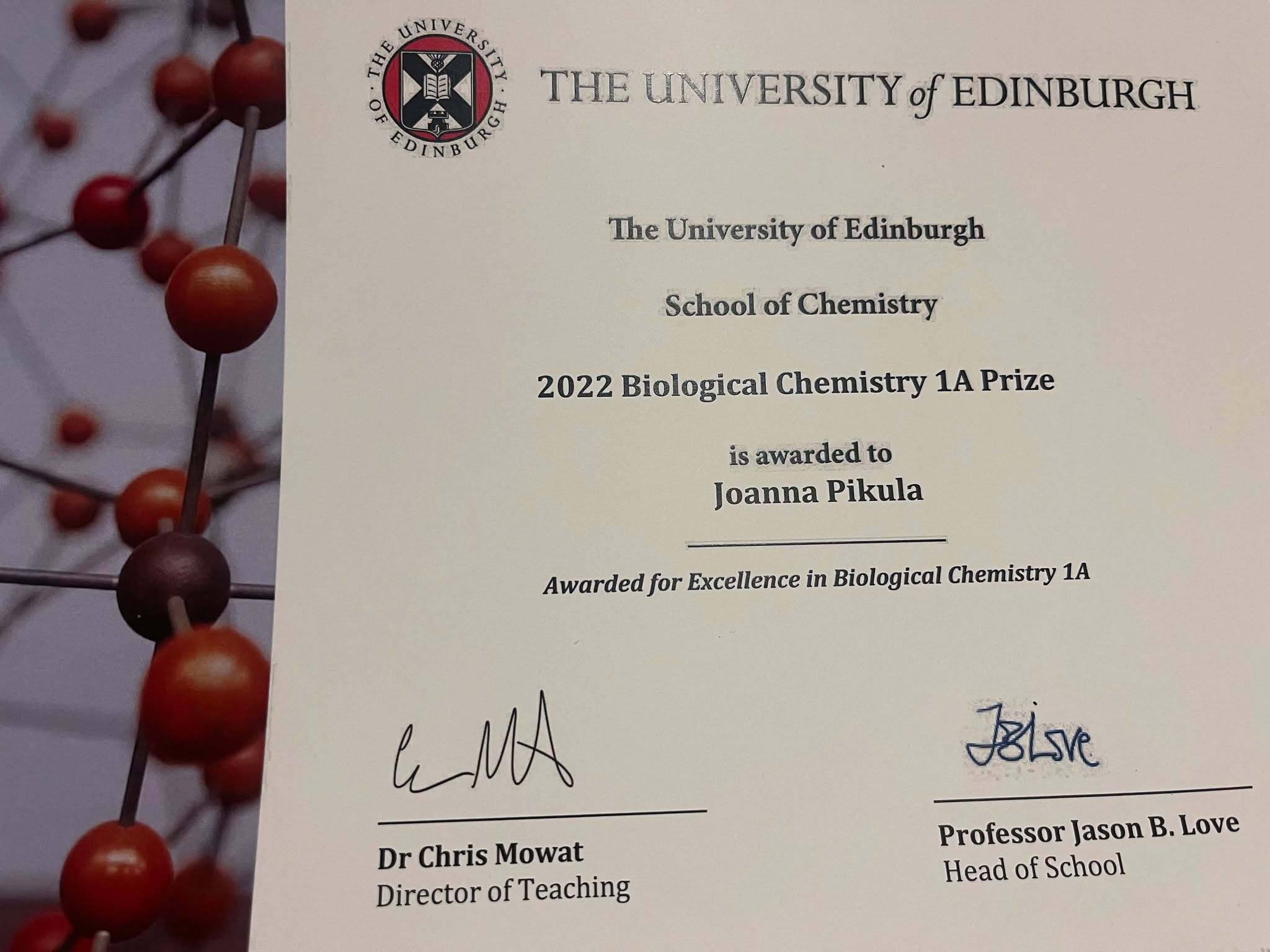
2022 Biological Chemistry 1A Class certificate - achieved for excellence (outstanding academic performance) in Biological Chemistry 1A
University of Edinburgh
Prion diseases are fatal neurodegenerative disorders caused by the misfolding of the prion protein into infectious forms that spread throughout the CNS. Perineuronal nets (PNNs) - specialized extracellular matrix structures involved in synaptic stability and plasticity - may play a previously unrecognised role in prion disease neuropathogenesis. Vulnerability of parvalbumin-expressing interneurons, which are surrounded by PNNs, has been observed in some prion diseases, but the potential contribution of PNNs to disease progression remains unclear. My research investigates the relationship between PNNs and prion-induced neurodegeneration, aiming to determine how changes in PNN integrity correlate with disease pathology.
Using a well-characterized murine model of prion disease derived from sheep scrapie, I examined PNN integrity across different experimental conditions, including astrocyte deficiency, microglia deficiency, and genetic background variations. Additionally, I analyzed the spatiotemporal relationship between PNNs and some populations of neuronal and glial cells to assess how these structures may be affected in prion disease.
As a rapidly progressing and well-characterized neurodegenerative disorder, prion disease serves as a valuable model for studying mechanisms of neuronal vulnerability and disease progression. Investigating PNN alterations in this context may provide broader insights into neurodegeneration beyond prion diseases, particularly in conditions where PNN disruption plays a role.
Both Sessions
N/A
University