
Entry Information
Tianyi Ding
Dr
Female

05/04/1996
China
Passport
E7183
Chinese
Email hidden; Javascript is required.
+8613052332160
No.1239 Siping Road, Yangpu District
Shanghai
China
Life Science and Medicine
Mathematical Sciences
I am a postdoctoral researcher at the School of Life Sciences and Technology, Tongji University, focusing on the epigenetic regulation of cancer. My research explores how epigenetics mediates the spatial co-transcription of genes, influencing tumor progression. By integrating 3D genomics, chromatin architecture, and non-coding RNA biology, I aim to uncover novel mechanisms that drive tumorigenesis and identify potential therapeutic targets.
The Hong Kong Laureate Forum provides an unparalleled opportunity to engage with esteemed Shaw Laureates and outstanding young scientists worldwide. I am particularly eager to discuss how chromatin topology and RNA-based regulatory mechanisms contribute to disease progression and exchange insights on cutting-edge methodologies in cancer epigenetics and single-cell transcriptomics.
Attending this forum will allow me to broaden my interdisciplinary perspective, foster potential collaborations, and gain valuable mentorship from world-class experts in life sciences. By participating, I aspire to contribute to scientific dialogues that transcend disciplines, ultimately advancing our understanding of fundamental biological processes and their implications in medicine.
I am enthusiastic about the prospect of joining this prestigious event and look forward to contributing my expertise while learning from the distinguished scientific community.
Postdoc
Life Science and Medicine
Tongji University
Shanghai
First Academic or Research Referee *
He Zhang
Tongji University
Professor
Email hidden; Javascript is required.
Second Academic or Research Referee
Chao Zhang
Shanghai Jiao Tong University
Professor
Email hidden; Javascript is required.
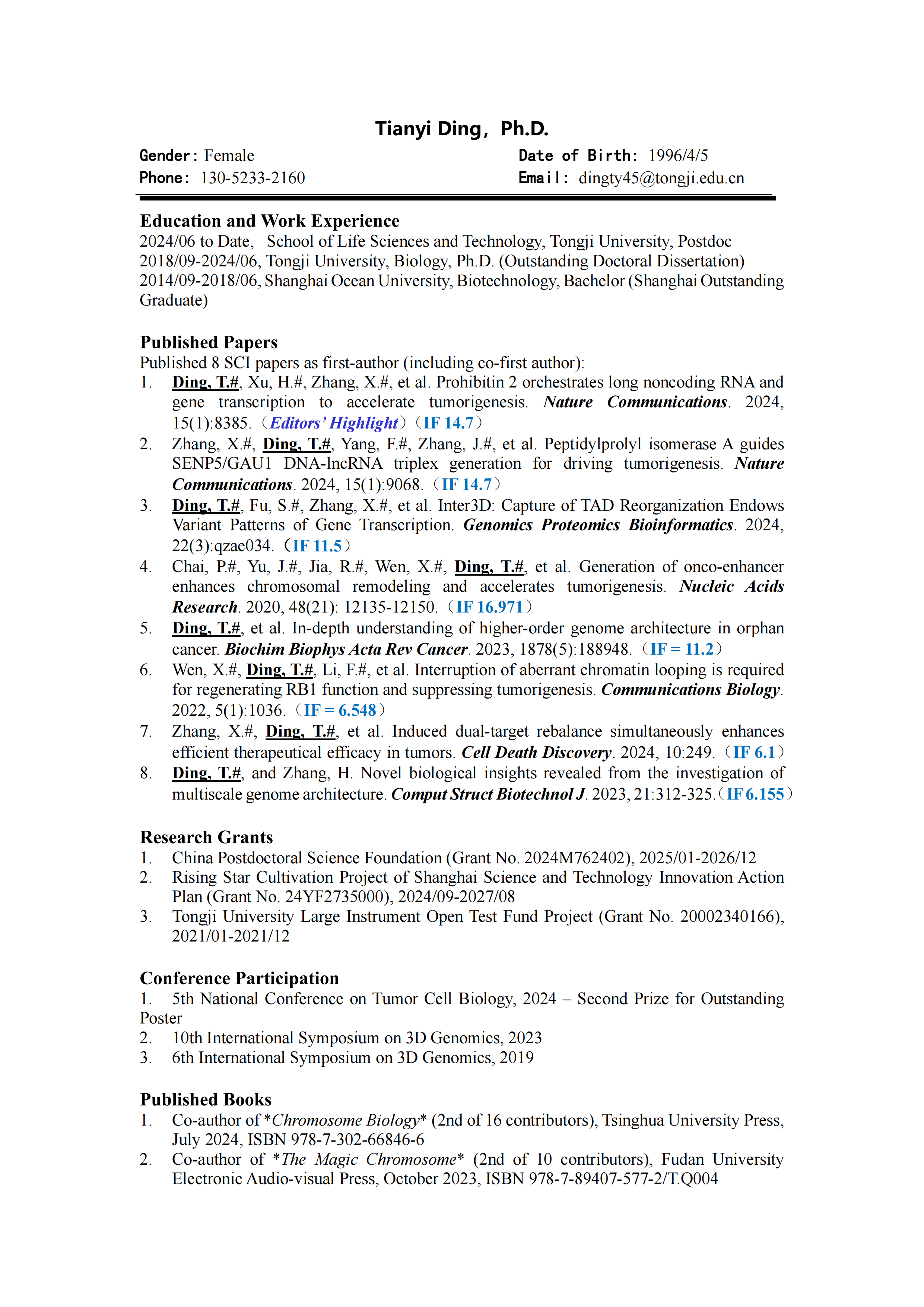
I am Dr. Tianyi Ding, a postdoctoral researcher at Tongji University, with a strong focus on tumorigenesis and genome architecture. I have published 8 SCI papers, 5 of which are in journals with an impact factor above 10, including 2 Nature Communications (IF 14.7) and Nucleic Acids Research (IF 16.971). I was honored with the Excellent Doctoral Dissertation Award from Tongji University and Shanghai Outstanding Graduate. Currently, I am leading several national and provincial-level research projects, including funding from the China Postdoctoral Science Foundation and Shanghai Science and Technology Innovation Action Plan.
My research focuses on the epigenetic regulation of melanoma, particularly how PHB2 mediates the spatial co-transcription of lncRNAs and coding genes to influence tumor progression. By integrating 3D genomics, chromatin accessibility profiling, and RNA biology, I aim to uncover novel regulatory mechanisms driving melanoma development and identify potential therapeutic targets.
Recent findings from my work suggest that PHB2 orchestrates chromatin loop formation, facilitating interactions between oncogenic super-enhancers and target genes. Moreover, PHB2 recruits histone modifiers, such as H3K27ac and H3K14ac-associated enzymes, to establish an active chromatin landscape, promoting the transcription of tumor-associated lncRNAs. Notably, PHB2 also mediates the mitochondrial localization of oncogenic lncRNAs, influencing mitochondrial DNA stability and metabolic reprogramming in melanoma cells.
By elucidating these lncRNA–chromatin–mitochondria interactions, my research aims to provide fundamental insights into how epigenetic reprogramming drives melanoma progression. I am particularly interested in how non-coding RNAs and chromatin topology shape tumor heterogeneity and resistance to therapy. Ultimately, my goal is to translate these findings into novel RNA- and epigenetics-based therapeutic strategies for melanoma.
Both Sessions
N/A
University