
Entry Information
Juliana Tsz Yan Choi
Ms
Female

05/07/1999
Hong Kong
Hong Kong Identity Card
Y7285
Chinese
Email hidden; Javascript is required.
+447440114002
Pembroke College, St Aldates
Oxford
United Kingdom
Life Science and Medicine
N/A
As a PhD student investigating how neuromodulators shape dopaminergic networks, I am passionate about uncovering the molecular principles that drive fundamental behaviours like learning and memory. My research bridges molecular biology, neurogenetics, and behavioural neuroscience to understand how animals adapt to changing environments. The Hong Kong Laureate Forum offers a unique opportunity to share insights with fellow young scientists and learn from Shaw Laureates such as Eva Nogales, whose structural work on macromolecular complexes can inform my understanding of neuromodulatory receptor function and help refine the molecular basis of memory formation.
Having grown up in Hong Kong, I am especially excited by the chance to engage with its scientific community. I hope to better understand the local research landscape and explore how fundamental neuroscience research like mine can contribute to and evolve within Hong Kong’s academic landscape. I also look forward to building meaningful relationships with peers from around the world, learning from their diverse scientific approaches, and exchanging ideas that push the boundaries of scientific discovery.
Ultimately, I aspire to bring my neuroscience training and international experience back to my hometown, supporting its growth as a hub for cutting-edge research, innovation, and inclusive science education.
Postgraduate (PhD)
Neuroscience
University of Oxford
Oxford
First Academic or Research Referee *
Scott Waddell
University of Oxford
Professor of Neurobiology/Deputy Head of Department
Email hidden; Javascript is required.
Second Academic or Research Referee
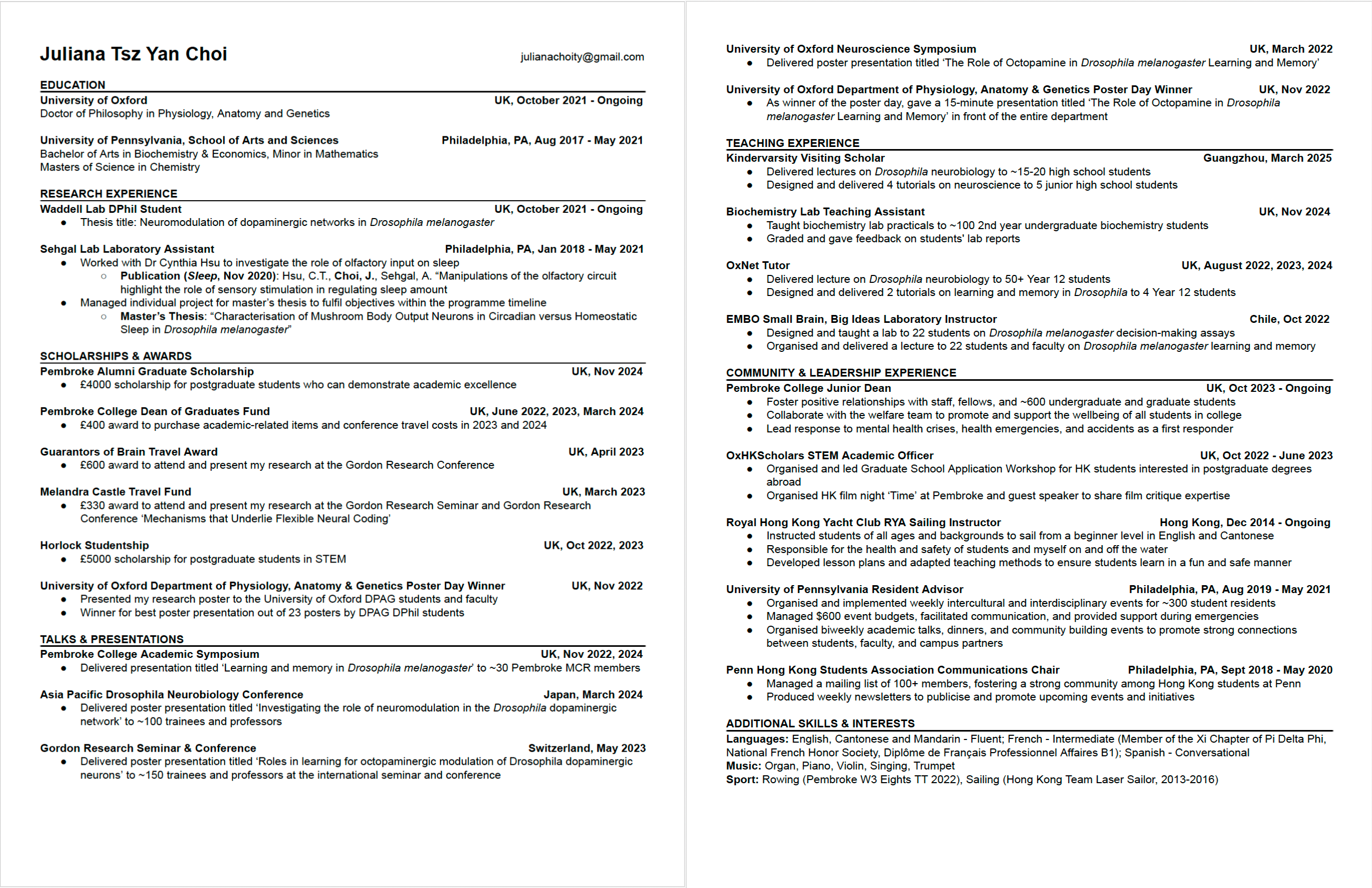
Pembroke Alumni Graduate Scholarship, Pembroke College Dean of Graduates Fund, Guarantors of Brain Travel Fund, Melandra Castle Travel Fund, Horlock Studentship, University of Oxford Department of Physiology, Anatomy & Genetics Poster Day Winner
Fruit flies (Drosophila melanogaster) can learn to associate specific smells with food, helping them find resources more effectively in the future. This type of learning takes place in a brain region called the mushroom body (MB), where odour information from Kenyon cells (KCs) is integrated with signals from dopaminergic neurons (DANs). When an odour is paired with a reward, dopamine is released, driving synaptic plasticity between KCs and MB output neurons to guide future behaviour—either approaching or avoiding that smell. Different groups of DANs are modulated by various monoamines and neuropeptides, which may fine-tune how learning occurs. To better understand this regulation, we used single-cell transcriptomics to map which neuromodulatory receptors are expressed in specific DAN subtypes. We are now using genetic loss-of-function experiments to investigate whether these receptors contribute to how flies form and retain memories of rewarding odours. This work sheds light on the complex molecular and cellular mechanisms that support learning and memory in the fly brain.
Flash Presentation Session
N/A
Peers