
Entry Information
Man Chun Yeung
Mr
Male
18/12/2000
Hong Kong
Hong Kong Identity Card
Y7778
Chinese
Email hidden; Javascript is required.
+14144299504
2333 N Oakland Ave Apt 302
Milwaukee, WI
United States
Astronomy
Mathematical Sciences
As a student who studies in the United States now, I have attended several conferences across the U.S. and Europe. One of the most rewarding outcomes is the chance to engage with local researchers. The forum presents an opportunity to connect with researchers and brilliant minds in Hong Kong, fostering potential future collaborations and building connections.
I also see the forum will be a place for both learning and giving. Being a Hong Kong resident, I have long heard of the Shaw Prize and its role in recognizing important contributions to science. Meeting with these scholars in the field would be a precious experience. I look forward to learning from their valuable insights and perspectives which would inspire my research. At the same time, I hope to give back by sharing my story as a PhD student abroad. Having been an undergraduate in Hong Kong myself, I understand uncertainties students may feel about pursuing research or studying overseas. I would be glad to share my experience and offer guidance to the younger generation.
Postgraduate (PhD)
Astrophysics with gravitational waves
University of Wisconsin-Milwaukee
Milwaukee, WI, USA
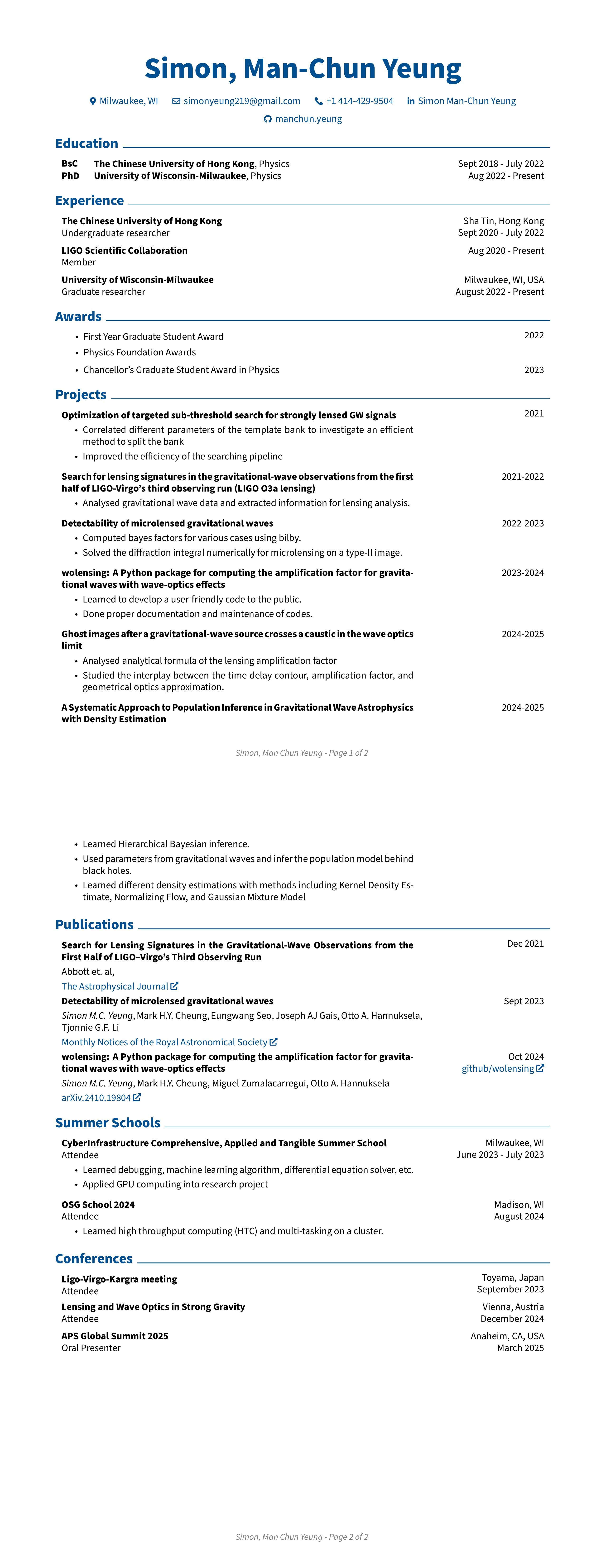
The Chinese University of Hong Kong
First Academic or Research Referee *
Professor Jolien Crieghton
University of Wisconsin-Milwaukee
Professor
Email hidden; Javascript is required.
Second Academic or Research Referee
Professor Otto A. Hannuksela
The Chinese University of Hong Kong
Assistant Professor
Email hidden; Javascript is required.
University of Wisconsin-Milwaukee:
First Year Graduate Student Award
Physics Foundation Awards
Chancellor’s Graduate Student Award in Physics
My research interest is astrophysics with gravitational waves. I have been working on gravitational wave (GW) lensing since undergraduate. When a gravitational wave is lensed by a massive object, there are multiple copies of the signal with different magnifications and arrival times. We study the microlensing of GW by stellar objects and compute the wave optics amplification factor which is introduced when the size of the lens is comparable to the wavelength of the GW. Recently, we are working on the diffraction effect of lensing near caustic.
In addition, I also work on the population inference of GW. Astrophysical models, which are based on our understanding of the universe, can be built to describe the distribution of the black hole parameters including masses, spins, and redshifts. In the standard approach, posterior distributions of the black hole parameters undergo Monte Carlo integration to obtain the population parameters. We study the systematics of replacing the posteriors with density estimates using machine learning techniques including Gaussian Mixture Model and Normalizing Flow.
Poster Presentation Session
N/A
Peers