
Entry Information
Negin Saeedi
Dr
Female
30/12/1991
Iran
Passport
T5631
Iranian
Email hidden; Javascript is required.
+989123213024
Physiology Department, School of Medicine, Shahid Beheshti University of Medical Sciences, velenjak, Tehran,Iran
Tehran
Iran
Life Science and Medicine
Life Science and Medicine
I think an excellent chance to have experience with cutting-edge approaches is provided by this course. I'm really curious to be there to have new experiences. In addition to my own research interests, taking this course will enable me to provide advanced techniques that aren't yet available in Iran. I hope to use and instruct these advanced methods as a future faculty member, supporting the advancement of neuroscience research in my nation. In addition to helping me improve my scientific methodology, this course will provide me the opportunity to guide students and future investigators in using modern tools to tackle challenging neurophysiological issues. My long-term objective is to encourage translational neuroscience by incorporating advanced circuit analysis techniques into studies of addiction and neurodegeneration. A critical initial step in accomplishing this goal will be enrolling in this course, which will provide me the tools I need to close the knowledge gap between Iranian neuroscience research and international developments.
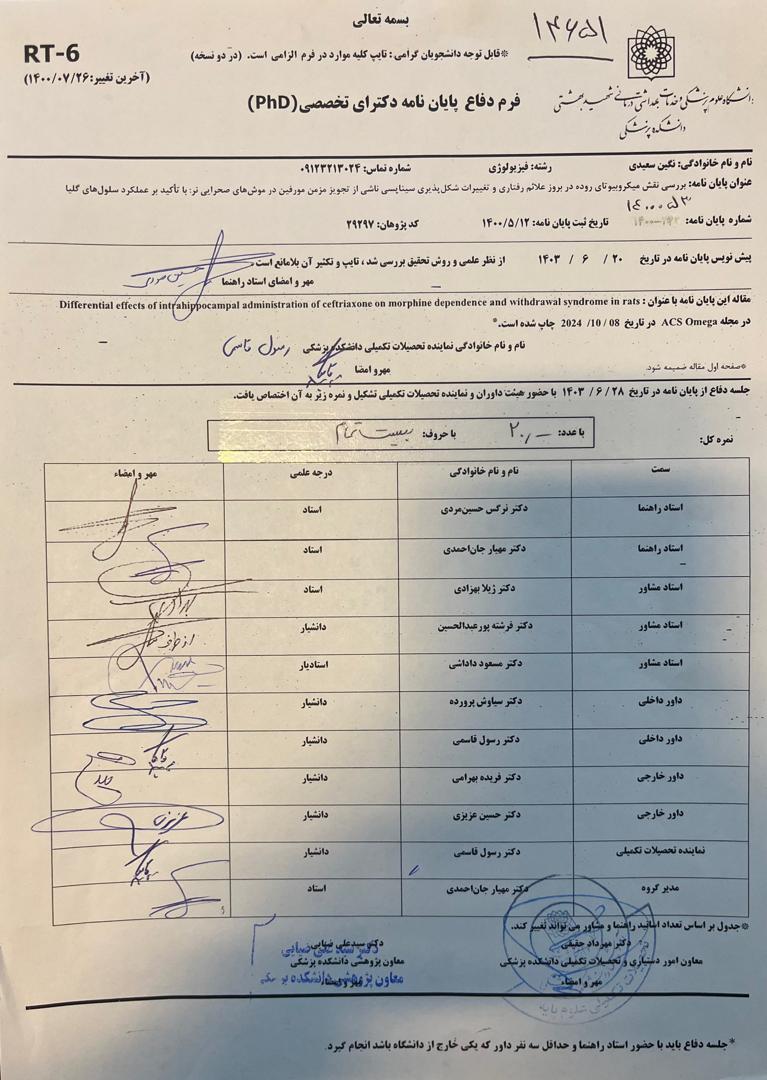
PhD Graduate
Neurophysiology
Shahid Beheshti University of Medical Sciences, School of Medicine, Physiology Department
Tehran, Iran

First Academic or Research Referee *
Prof. Narges Hosseinmardi
Shahid Beheshti University of Medical Sciences, School of Medicine, Physiology department
Professor
Email hidden; Javascript is required.
Second Academic or Research Referee
Prof. Mahyar Janahmadi
Shahid Beheshti University of Medical Sciences, School of Medicine, Physiology department
Professor
Email hidden; Javascript is required.
Understanding the neurophysiological processes that underlie addiction is the goal of my study, especially how the gut-brain axis contributes to neurological and behavioural alterations brought on by opioids. I studied how changes in gut microbiota affect synaptic plasticity in addiction. To investigate the relationship between microbiota, brain circuits, and addiction-related behaviours, my research used behavioural experiments, electrophysiological recordings, molecular, and histology methods. Understanding the intricate neurobiological processes that underlie addiction is the main goal of my study, with a focus on the functions of neurones and glial cells. We have examined the role of glial cells, transporters, and channels in the onset and maintenance of addiction in a number of studies. Our research has demonstrated the critical roles that these cellular constituents play in the neurophysiological dysfunctions linked to addiction and other neurological conditions. My work has lately broadened to investigate the gut-brain axis, looking at how changes in gut microbiota affect neurophysiological reactions and behaviours associated with addiction. In particular, we have examined how probiotics and faecal microbiota transplantation affect addiction, evaluating their impacts on electrophysiological and behavioural measures. These investigations have offered fresh perspectives on how microbiota-focused therapies could alter synaptic plasticity and brain circuitry linked to addiction.
Both Sessions
N/A
Peers